
By the middle of the 2000s, leather no longer had anything to prove. It had been couture, counterculture and luxury in turn, so the years from 2005 to 2009 became something quieter and more interesting, a period of pure refinement. Designers stopped asking what leather could symbolise and started asking what else it could physically do. They rebuilt the trench, stretched the skin, wove it into fabric and painted it in colours nobody expected. Here is how leather jackets from 2005 to 2009 turned the classics inside out.
In the late 2000s the question was no longer whether leather belonged in fashion, but how far a single skin could be pushed.
2005: the year of the trenchsuit
The established houses opened the period by playing with the most familiar silhouette of all. Bottega Veneta and Hermes both kept offering fascinating leather fashion, and each took the trench to a new level with a tan leather trenchsuit, a combination of trench coat and jumpsuit in one flowing piece. Bottega Veneta, known above all for hand woven leather accessories, also produced a stunning maize leather trench coat that year, while Hermes finished its own melding of trench and trouser suit with fine decorative topstitching.
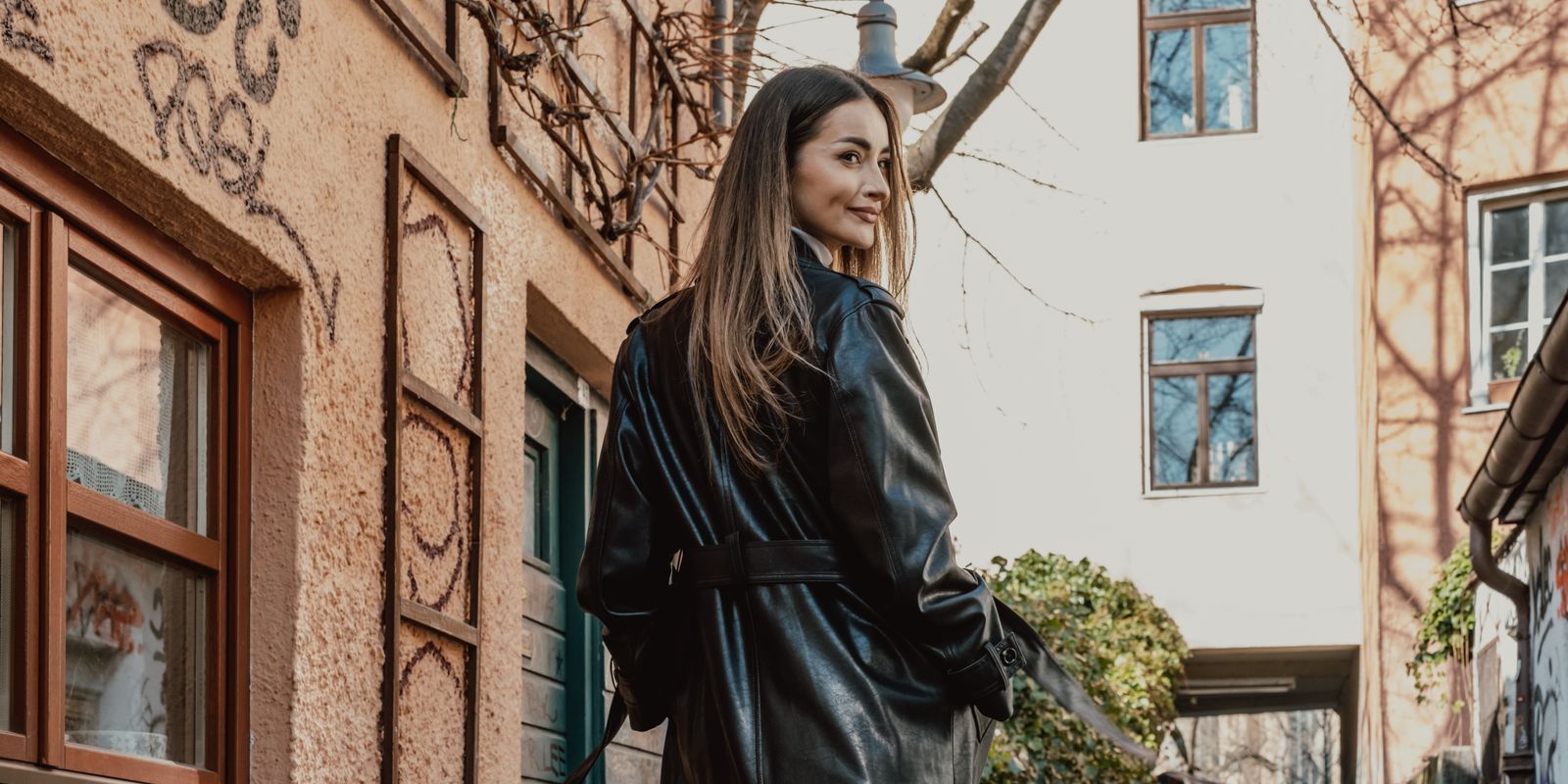
The newer names pulled in a rawer direction. The American manufacturer D-Squared reworked its signature attitude in a pair of hip hugging orange leather cropped trousers, complete with zipped and patch pockets, making the most of everything the tanner’s craft could offer. Rick Owens answered with an edgy cropped shearling jacket whose asymmetric hem showed how cleverly colour variations between two skins could be used. The lesson of 2005 still holds: a long leather silhouette reads instantly as luxury, which is exactly what a piece like the women’s long natural leather trench coat delivers today.
2006: classics subverted
If 2005 rebuilt the trench, 2006 went after the icons. Karl Lagerfeld, who had begun transforming the Chanel image back in 1983, showed just how far he had come by pairing a black leather micro mini skirt and over the knee leather boots with a classic cream wool Chanel jacket trimmed with pearls. A long chiffon waistcoat pushed the ensemble even further from tradition. It was a masterclass in contrast, the toughest material in fashion set against the softest codes of the house.
John Galliano, always devoted to leather, included an off white shearling jacket in his collection for Dior, using darts not just for shape but as a decorative touch. Dolce and Gabbana stayed true to their experimental streak and combined smooth blue nappa with blue embossed ostrich leather on a military inspired jacket, proof that exotic textures could give even the strictest silhouette a new voice. That love of generous, tactile shearling is exactly what an oversized piece such as the women’s Velocite oversized shearling jacket carries forward now.

2007: playful minis and classics with a twist
By 2007 a new generation had arrived. The newest designers took leather to another level with ultra mini, sexy yet playful leather dresses, and the Glasgow born, London based Christopher Kane led the way. For his autumn and winter 2007 collection he stepped away from his signature bondage look into a world of leather and velvet, creating a burgundy ensemble that felt fresh precisely because it refused to take leather too seriously.
The legends answered with classics with a twist. MaxMara, famous for coats and suits since 1951, ventured deeper into ready to wear with a beautiful brown sleeveless leather tunic, belted and effortless. Miu Miu treated leather exactly like fabric, showing a full front pleated leather skirt paired with a matching short jacket. And at Vuitton, Marc Jacobs used the thinnest, softest leather available to create a rust coloured top and shirt ensemble that draped like silk. The message of 2007 was simple: leather could be as light, as playful and as wearable as anything else in the wardrobe.
2008: craft, stretch and woven skins
The next year belonged to technique. Designers kept their own individual take on leather while exploiting the vast range of finishes the tanneries now offered, and some went further and created their own leather fabrics using plaiting and weaving. Jordan Betten of Lost Art stayed true to his philosophy, building one of a kind pieces that took more than one hundred hours each, including a top made entirely from fine strips of leather, woven and knotted by hand so no two garments could ever be alike.
Richard Chai, the Korean American designer, used shearling to build a collection of experimental shapes, among them a sleeveless shrug in rust coloured shearling. The French designer Jean Claude Jitrois, one of the first ever to include stretch leather in his collections, kept refining it, bringing the tuxedo and trousers right up to date in black stretch lambskin. Stretch mattered because it solved an old problem: the baggy knee and saggy seat that skin tight leather always suffered from. And Hermes, harness maker since 1837, played on its riding heritage with brown suede jodhpurs designed to be worn both on and off a horse.
2009: colour, architecture and a catwalk full of leather
Leather is often said to peak in cycles of three years, yet the world’s top designers have almost always kept it in their collections, and in 2009 it was everywhere on the catwalks. The Swiss house Bally showed the sophistication of a tan knee length novelty skirt paired with a black halter top. Rick Owens went the other way entirely, combining an architecturally cut black sleeveless leather jacket with baggy trousers, a silhouette that looked carved rather than sewn.
The most joyful statement came from New York. The duo Duckie Brown took a classic jacket shape and executed it in a striking, unusual orange, using calf leather specially treated to be extra soft and yet resilient. It closed the decade with a grin, proof that after a hundred years of history the leather jacket could still surprise. That same spirit of bold colour on a classic cut lives in the women’s red cropped racer sheepskin jacket, a modern echo of 2009’s brightest idea.
How to wear the 2005 to 2009 look now
This era translates almost directly into a modern wardrobe because it was built on wearability. Borrow the 2005 idea by letting one long leather piece carry the whole outfit, a trench or long coat over the simplest knitwear and trousers. Channel 2006 by mixing codes, a structured leather piece against something soft and classic, tough and tender in the same frame.
From 2007, take permission to have fun, a leather skirt or cropped jacket styled as casually as denim. From 2008, look for craft details, visible weaving, careful stitching, a fit that moves with the body instead of fighting it. And from 2009, trust colour. One bright leather jacket over calm neutrals still does what Duckie Brown proved it could: it turns a classic into a statement without a single logo.
What these five years left behind
Between 2005 and 2009 leather completed its long journey from armour to fabric. It was pleated like wool, woven like cloth, stretched like jersey and coloured like silk. The period handed us the oversized shearling, the leather trench revival and the bright statement jacket, three ideas that modern wardrobes still lean on every winter. Most of all it proved that the classics are never finished, only waiting for the next pair of hands.
Conclusion
From the tan trenchsuits of Bottega Veneta and Hermes to Jitrois in stretch lambskin and Duckie Brown in soft orange calf, the years from 2005 to 2009 treated leather as a living craft. The old houses rebuilt their icons, the new names played, and the tanneries kept handing both sides better skins. Every trench, shearling and boldly coloured leather jacket hanging in a wardrobe today carries a little of those five inventive years on its shoulders.
Frequently asked questions
What defined leather fashion from 2005 to 2009?
Reinvention of the classics. Houses like Bottega Veneta and Hermes rebuilt the trench, Lagerfeld put a leather micro mini into Chanel, and designers such as Christopher Kane made leather playful. Weaving, stretch technology and exotic textures kept pushing the material further every season.
What was the trenchsuit of 2005?
It was a combination of trench coat and jumpsuit in tan leather, offered by both Bottega Veneta and Hermes. It took the most classic silhouette in outerwear and turned it into a single sculpted leather piece, and it summed up the era’s appetite for rebuilding familiar shapes.
Why was stretch leather important in this period?
French designer Jean Claude Jitrois, one of the first to use stretch leather, kept it central to his collections. Stretch technology removed the baggy knees and sagging seat that skin tight leather used to suffer from, so fitted leather clothing finally stayed sharp on the body.
Which shearling moments stood out between 2005 and 2009?
Rick Owens cropped an edgy shearling with an asymmetric hem in 2005, John Galliano put an off white shearling in his Dior collection in 2006, and Richard Chai built experimental shapes from shearling in 2008, including a rust coloured sleeveless shrug.
The iconic looks of the 2000s are back — browse the Buneri women’s leather jacket collection.